What is BPM in Music? The Complete Guide to Beats Per Minute
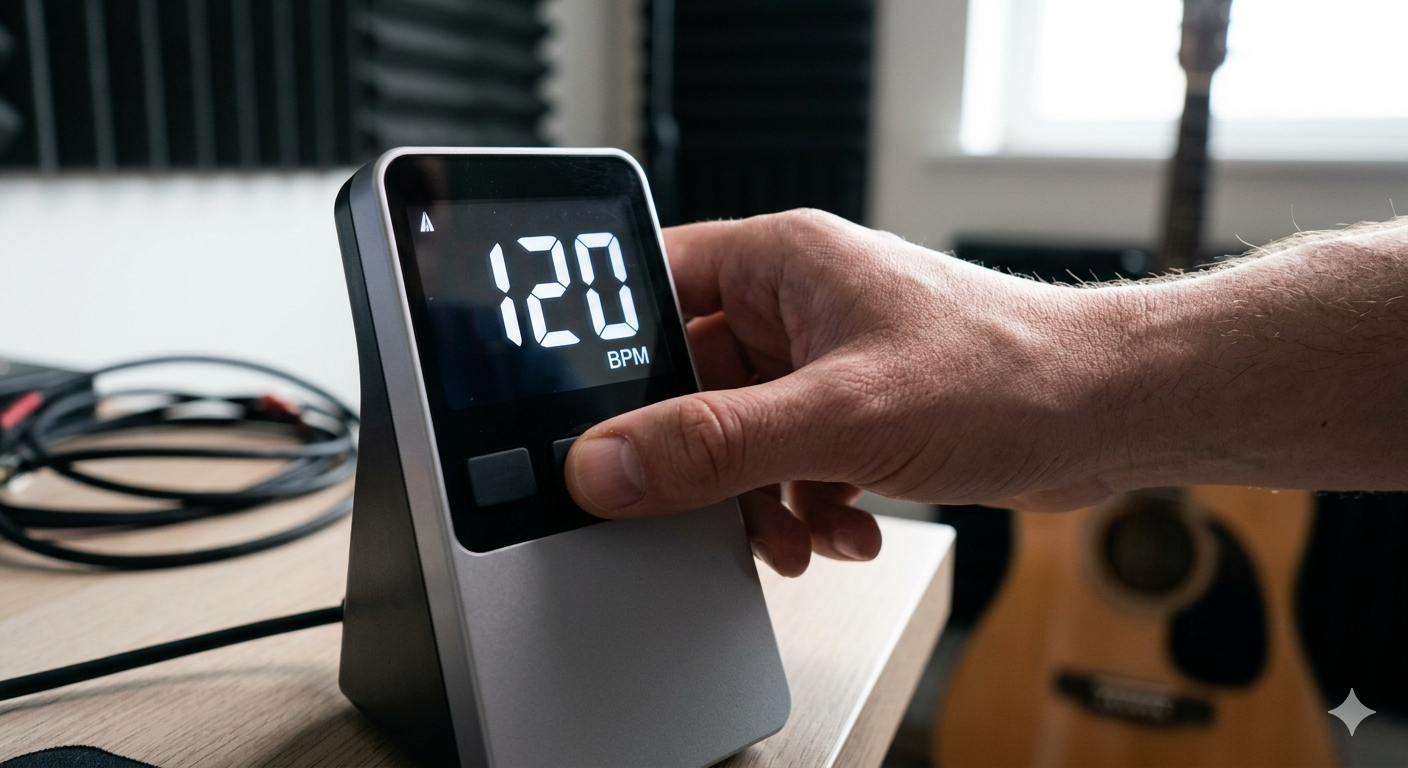
BPM — beats per minute — is the universal unit of musical tempo. It appears in every DAW, every DJ app, every metronome, and every piece of sheet music that carries a tempo marking. Understanding what BPM means, why it matters, and how it shapes music across every genre gives you a practical tool whether you are a producer, DJ, musician, runner, or simply a curious listener. This guide covers everything: the exact BPM definition, its history, how it relates to time signature and Italian tempo terms, the BPM ranges that define each genre, and how to measure the beats per minute of any song in seconds.
What Does BPM Stand For?
BPM stands for beats per minute. It is the numerical measurement of musical tempo — a count of how many individual beats occur within a 60-second window of music. The number tells you, with complete precision, how fast a piece of music is moving.
A song at 60 BPM has exactly one beat per second. At 120 BPM the beats arrive twice as fast — two per second. At 180 BPM there are three beats every second. The higher the number, the faster the track.
Unlike vague descriptors such as “fast” or “slow”, BPM gives an exact, universally understood measurement that works across every genre, every instrument, every DAW, and every country. A producer in Seoul and a DJ in London both understand 128 BPM instantly and identically. That precision is why beats per minute became the global standard for communicating musical speed.
BPM, Tempo, and Beat — What Is the Difference?
These three terms are closely related but not interchangeable. Understanding the distinction makes every other concept in this guide clearer.
What is Tempo in Music?
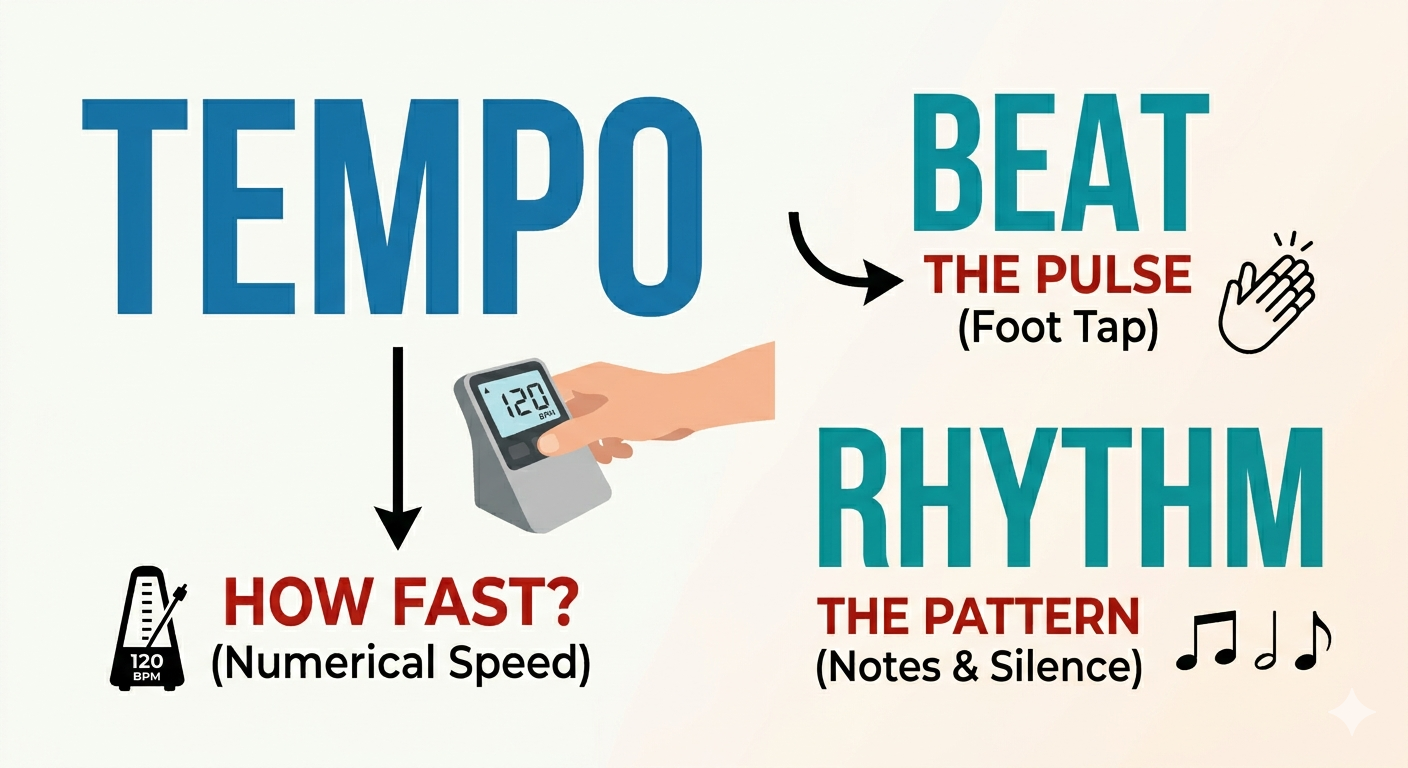
Tempo is the concept of musical speed — how fast or slow a piece of music moves. Tempo is a general idea. You can describe tempo with words (fast, slow, moderate), with Italian markings (Allegro, Andante, Largo), or with an exact numerical value. When you express tempo as an exact number, that number is the BPM. BPM is the precise, numerical form of tempo — the measurement unit for musical speed.
What is a Beat in Music?
A beat is the basic rhythmic unit of music — the steady pulse you naturally tap your foot to when you hear a song. In a bar of 4/4 time, there are four beats per measure. In 3/4 (waltz time) there are three. The beat is what BPM counts. Every time a beat occurs, one unit toward the total beats per minute is added.
What is Rhythm in Music?
Rhythm is the pattern of sounds and silences arranged across those beats. A drum fill, a syncopated guitar riff, a vocal melody — these are all rhythmic patterns that occur within the framework the tempo provides. Rhythm describes what happens across beats. Tempo describes how fast those beats arrive. BPM measures that speed.
What is a Metronome Marking?
A metronome marking is another name for a BPM value written in sheet music. It is expressed as a note value equals a number — for example ♩ = 120 — meaning the quarter note equals 120 beats per minute. Some musicians use the abbreviation M.M. (Maelzel’s Metronome) before the number in older scores.
A Brief History of BPM — From Metronomes to DAWs
The idea of measuring musical speed precisely is older than most people expect. Before the 19th century, composers communicated tempo entirely through Italian descriptive terms — Allegro (fast), Adagio (slow), Largo (very slow). These terms conveyed mood and feel more than exact speed, leaving interpretation entirely to the performer.
The Invention of the Metronome
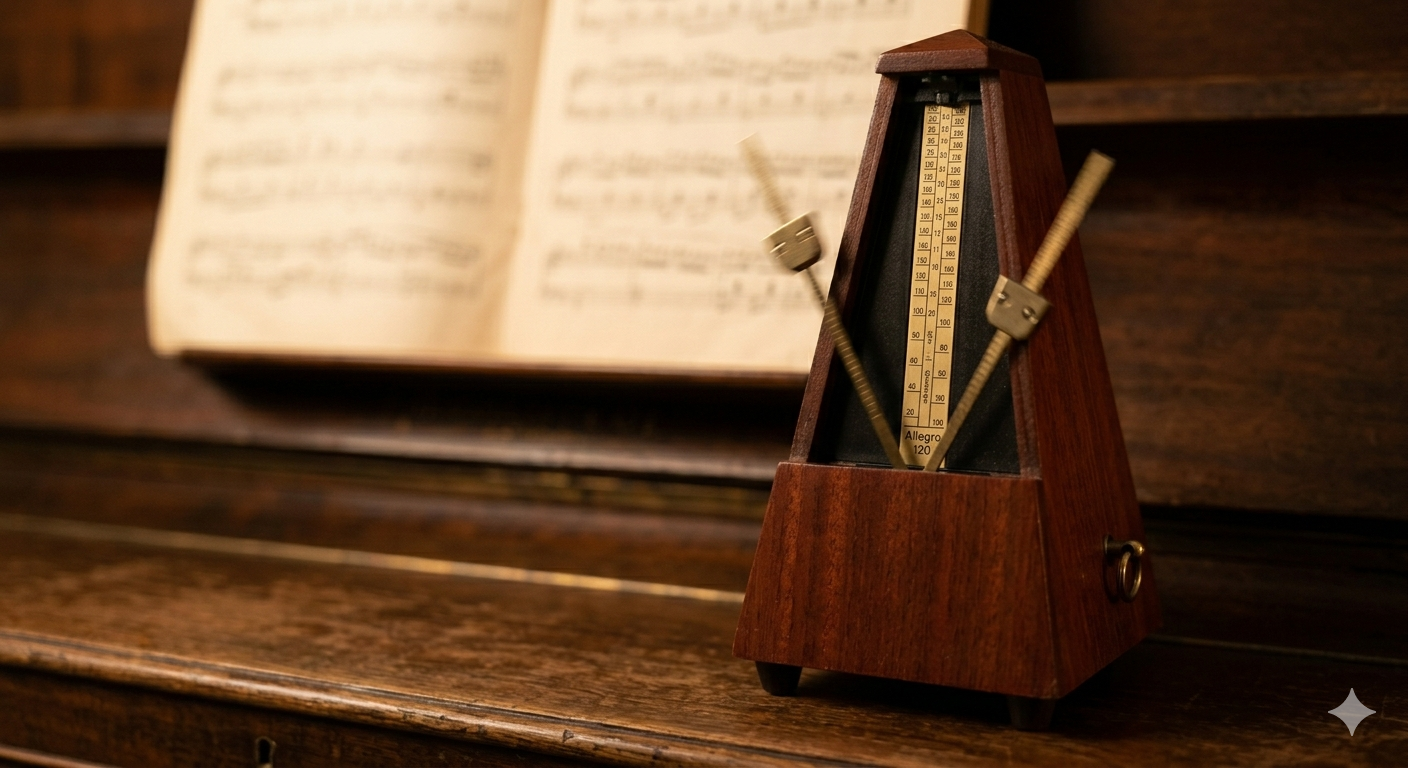
In 1815, Johann Nepomuk Maelzel patented the mechanical metronome — a weighted pendulum device that produces a steady audible tick at a set speed. The device allowed composers to specify tempo with complete precision for the first time. Ludwig van Beethoven was among the first major composers to adopt it, adding specific metronome markings to his symphonies from 1817 onward.
The mechanical metronome introduced the concept that tempo could be expressed as a number of beats per minute. That number is what we now universally call BPM.
BPM in Electronic Music and DAWs
The term beats per minute moved to the centre of music production in the late 20th century with the rise of drum machines, MIDI sequencers, and digital audio workstations. Electronic dance music genres — house, techno, drum and bass, trance — are entirely built around fixed BPM grids. Every element of a track is locked to a master tempo, and that tempo is expressed as a BPM value.
Modern DAWs including Ableton Live, FL Studio, Logic Pro, and GarageBand all display the project tempo as BPM in the main toolbar. Every loop, audio sample, and MIDI sequence in the project is tied to that master BPM value. Understanding what BPM means is therefore foundational to understanding how modern music production works at every level.
BPM and Time Signature — How They Work Together
BPM and time signature are two different but deeply related concepts that together define how music is structured in time. Many beginners confuse them or assume they mean the same thing. They do not.
What is a Time Signature?
A time signature tells you how many beats are in each measure (bar) of music and what note value counts as one beat. It appears as a fraction at the start of a piece of sheet music. Common time signatures include:
- 4/4 — four beats per measure, quarter note gets one beat. The most common time signature in pop, rock, and electronic music. Also called common time.
- 3/4 — three beats per measure. Produces the waltz feel. One-two-three, one-two-three.
- 6/8 — six eighth-note beats per measure, grouped as two sets of three. Compound duple metre.
- 5/4 — five beats per measure. Odd metre, used frequently in jazz and progressive rock.
- 7/8 — seven eighth-note beats per measure. Complex, asymmetrical feel used in math rock and some folk traditions.
How BPM and Time Signature Interact
BPM measures beat speed. Time signature determines what counts as a beat and how many beats appear per bar. Two songs can share the exact same BPM but feel completely different if their time signatures differ.
A track at 120 BPM in 4/4 feels like a driving pop or house record. The same track at 120 BPM in 3/4 feels like a medium-tempo waltz. The speed is identical. The rhythmic structure and feel are completely different.
This is why BPM alone does not fully describe music — it only tells you how fast. The time signature tells you the pattern those beats fall into.
When identifying the BPM of a song with an unusual time signature — 6/8, 7/8, 5/4 — decide first whether you are counting quarter notes or eighth notes as the beat. For DJ beatmatching and most production contexts, the quarter-note pulse is the correct reference point.
Italian Tempo Markings and Their BPM Equivalents
Before BPM became universal, composers used Italian tempo markings to indicate speed. These terms remain in use today — particularly in classical music, formal music education, and sheet music notation. Each corresponds to an approximate BPM range, though exact values vary by era, composer, and performance tradition.
| Italian Term | Meaning | BPM Range | Character |
|---|---|---|---|
| Larghissimo | Extremely slow | Under 24 BPM | The slowest possible tempo marking, rarely encountered |
| Grave | Solemn, heavy | 24–40 BPM | Very slow and serious, often used for funeral or solemn passages |
| Largo | Broad | 40–60 BPM | Very slow and stately — dignified and expansive |
| Lento | Slow | 45–60 BPM | Slow but not as heavy or solemn as Grave |
| Larghetto | Rather broad | 60–66 BPM | Slow but slightly more flowing than Largo |
| Adagio | At ease | 66–76 BPM | Slow and expressive — a common marking in emotional ballads and slow movements |
| Adagietto | Fairly slow | 72–76 BPM | Slightly faster than Adagio; notably used by Mahler in his 5th Symphony |
| Andante | Walking pace | 76–108 BPM | Moderate, relaxed, flowing — literally “at a walking pace” |
| Andantino | Slightly faster than Andante | 80–108 BPM | Light and gently moving |
| Moderato | Moderate | 108–120 BPM | Neither fast nor slow — a comfortable middle tempo |
| Allegretto | Moderately fast | 112–120 BPM | Lively but not as driven as Allegro |
| Allegro | Fast, lively | 120–156 BPM | The most commonly used fast tempo marking in classical and contemporary music |
| Vivace | Lively, brisk | 156–176 BPM | Fast and energetic — requires technical clarity |
| Presto | Very fast | 168–200 BPM | Rapid and demanding — common in virtuosic passages |
| Prestissimo | Extremely fast | 200 BPM and above | The fastest classical tempo marking — the absolute upper limit |
The free BPM counter at Find My BPM automatically displays the corresponding classical tempo name alongside the numerical BPM reading — useful for musicians working across both classical and contemporary contexts at the same time.
BPM Ranges by Music Genre — What Tempo Defines Each Style
Genre conventions around beats per minute are not arbitrary. They evolved because certain tempos produce specific physical and emotional responses in listeners and performers. A tempo that makes you want to dance is neurologically different from one that makes you want to sit and reflect. Here is how musical tempo breaks down across every major genre.
| Genre | Typical BPM Range | Notes |
|---|---|---|
| Ambient / Drone | 40–80 BPM | Often pulse-free or very slow, designed for atmospheric and background listening |
| Ballad (Pop / R&B) | 60–80 BPM | Slow, emotional, wide dynamic range — mirrors resting heart rate |
| Lo-fi Hip Hop | 70–90 BPM | Relaxed groove with vinyl texture, jazz chords, and minimal percussion |
| Hip Hop | 80–100 BPM | Boom-bap classics; trap often reads at half its true BPM in this range |
| R&B / Soul | 60–90 BPM | Smooth, groove-focused; overlaps with neo-soul at the lower end |
| Reggae | 60–90 BPM | Offbeat emphasis — the skank accent falls on the upbeat, not the downbeat |
| Blues | 60–100 BPM | Shuffle groove underpins most styles; slow blues 60–70, uptempo blues 90–100 |
| Jazz | 60–300 BPM | Extremely wide range — slow ballads to bebop at 300+; swing feel varies the perceived tempo |
| Country | 80–130 BPM | Slow ballads at the low end; uptempo honky-tonk and bluegrass higher up |
| Pop | 100–130 BPM | The radio-ready tempo range — energetic enough to engage without exhausting |
| Funk | 90–120 BPM | Groove and syncopation dominate; the feel matters more than the exact tempo number |
| Rock | 110–140 BPM | Wide variation — classic rock sits around 110–120, punk rock pushes 160 and above |
| Disco | 110–130 BPM | Four-on-the-floor kick at steady tempos engineered for dancefloor movement |
| Trap | 130–175 BPM | Double-time hi-hats make tracks feel faster than the nominal project BPM suggests |
| House | 120–130 BPM | The foundational EDM tempo — four-on-the-floor kick, consistent, dancefloor-ready |
| Deep House | 120–125 BPM | Lower end of the house range with more emphasis on groove, atmosphere, and space |
| Tech House | 124–132 BPM | Minimal, driving, percussion-heavy — bridges house and techno |
| Progressive House | 126–132 BPM | Long builds and melodic arcs; overlaps with melodic techno and melodic EDM |
| Techno | 130–150 BPM | Industrial, repetitive, hypnotic; Berlin techno sits around 135–140 BPM |
| Trance | 128–145 BPM | Melodic and euphoric builds; psytrance pushes toward 145–150 BPM |
| Dubstep | 138–142 BPM | Half-time feel makes the groove land around 69–71 BPM to the ear |
| Drum & Bass | 160–180 BPM | Fast syncopated breakbeats; liquid DnB at the lower end, neurofunk toward 175+ |
| Jungle | 160–180 BPM | Highly syncopated amen breaks — the direct predecessor to drum and bass |
| Hardcore (Electronic) | 160–200 BPM | Happy hardcore at 160–170; UK hardcore and terrorcore push higher |
| Gabber | 160–220 BPM | Distorted four-on-the-floor kicks, extreme tempo, Dutch origin |
| Punk Rock | 150–200 BPM | Fast, aggressive, short songs — speed is central to the genre identity |
| Metal | 100–220 BPM | Wide range — doom metal under 80, thrash 160–180, death metal blast beats 200+ |
| Classical | 40–200 BPM | Defined by Italian tempo markings; varies enormously across periods, forms, and composers |
For a full breakdown with production notes and DJ mixing guidance, see the complete BPM chart for every music genre — 40+ styles covered in one place.
Why BPM Matters — Real Applications Across Music and Beyond
Understanding what BPM is becomes most useful when you understand what people actually do with it. Beats per minute is not abstract music theory — it is a practical, working tool used daily by producers, DJs, musicians, athletes, and medical professionals.
BPM for Music Producers
In music production, the project BPM is set before a single note is recorded. Every element — MIDI sequences, audio loops, drum patterns, automation envelopes — locks to the master tempo. Import a sample recorded at 130 BPM into a project running at 120 BPM without identifying the mismatch first, and the sample will sound pitched or phased when the DAW time-stretches it to fit. Knowing the sample’s BPM before importing prevents this entirely.
DAWs including Ableton Live, FL Studio, Logic Pro, and GarageBand all include automatic BPM detection tools. For quick checks on unknown samples and loops without opening a full session, a free online tap tempo tool delivers the reading in seconds. Read the complete guide to how to find the BPM of any song for every method including DAW detection, audio waveform analysis, database search, and manual counting.
BPM for DJs
Beatmatching — synchronising the tempo of two tracks before mixing them — depends entirely on accurate BPM knowledge. If Track A is at 128 BPM and Track B is at 132 BPM, the DJ must pitch Track B down to match before aligning the beats. Modern DJ software calculates song BPM automatically for most known tracks. For unreleased or unidentified tracks, a tap tempo tool or BPM database provides the value instantly so transitions can be planned in advance.
Beyond beatmatching, DJs use BPM to structure sets — gradually increasing tempo to build energy, or intentionally dropping to a lower BPM to shift the crowd’s mood before a peak moment.
BPM for Musicians and Live Performance
For live musicians, BPM determines the click track and metronome settings for every rehearsal and performance. Playing along to a click track at the correct BPM keeps every musician synchronised even when stage monitors are imperfect and acoustic bleed is high. For guitarists using time-based effects, knowing the song’s BPM allows delay and tremolo pedals to be set correctly before the track begins. The BPM to milliseconds calculator converts any tempo to exact delay times for every note subdivision — quarter note, eighth note, dotted eighth, sixteenth note — so pedal settings lock perfectly to the beat every time.
BPM for Songwriters and Composers
When composing a new track, the tempo decision shapes everything that follows — the energy, the lyrical cadence, the chord rhythm, and the arrangement density. Most songwriters experiment with two or three tempo options before committing to one. A love song sketched at 75 BPM feels intimate and reflective. The same chord progression at 120 BPM becomes an upbeat pop track. Tempo is one of the most powerful and most overlooked compositional levers available — and it costs nothing to adjust.
BPM for Runners and Fitness
Music BPM influences physical movement through a process called auditory-motor synchronisation — the brain’s tendency to align physical rhythm with rhythmic audio cues. Runners who listen to music matched to their stride rate run more efficiently, maintain more consistent cadence, and report lower perceived exertion at the same actual effort. Most recreational runners benefit from music in the 140–180 BPM range, depending on pace and run type. For a complete breakdown by effort level and pace, see the full guide to best BPM for running.
BPM in Heart Rate and Medicine
Outside of music, BPM measures heartbeats per minute — the number of times the heart contracts in a 60-second window. A normal resting heart rate sits between 60 and 100 BPM for adults. Trained athletes often sit below 60 BPM at rest due to increased cardiac efficiency. The measurement unit is identical to music BPM — only the source of the rhythmic pulse differs.
How BPM Affects the Mood and Emotional Feel of Music
Tempo is one of the most direct and powerful influences on how a listener emotionally experiences a piece of music. The relationship between BPM and emotional response is not coincidental — it mirrors the human body’s own rhythmic systems and neurological responses to auditory stimulation.
Low BPM — Calm, Reflective, Melancholy
Tracks in the 60–80 BPM range tend to feel slow, introspective, and emotionally heavy. This range directly mirrors the resting human heart rate. When music pulses at the speed your resting body already does, the nervous system responds with calm and attentiveness. Funeral marches, slow ballads, ambient soundscapes, and meditation music all sit in this range for exactly this physiological reason.
Medium BPM — Natural, Conversational, Flowing
The 80–120 BPM range feels natural and unhurried. Much of pop, R&B, soul, and classic rock sits in this zone because it is energetic enough to hold attention but not so fast it creates tension or urgency. The Italian tempo markings Andante and Moderato fall precisely in this range — both describe music that moves at a comfortable, human-scale pace.
High BPM — Energetic, Urgent, Euphoric
Above 120 BPM the body responds with increased alertness, higher energy, and the physical urge to move. Dance music genres — house, techno, trance, drum and bass — operate in the 120–180+ BPM range because this tempo reliably produces movement. Research in sports psychology has shown that running and cycling at intensities matched to music in this range reduces perceived exertion and improves performance consistency.
How to Measure BPM — Finding the Beats Per Minute of Any Song
Knowing what BPM means is useful. Knowing how to measure it for any song is essential. There are five reliable methods, each suited to different situations and available tools.
Method 1 — Tap Tempo (Fastest and Most Accessible)
Play the song and tap along to the beat — using a button on screen or your keyboard spacebar. A tap tempo tool records the time interval between each tap and calculates a rolling average to produce an accurate BPM reading. After approximately 8 taps the result stabilises to within 1–2 BPM of the true value for most tracks.
The free BPM counter at Find My BPM uses this method and works on every device — mobile, tablet, and desktop — with no download or account required. The tool also displays the beat interval in milliseconds and the corresponding classical Italian tempo name alongside the BPM reading.
Method 2 — Manual Beat Counting
Set a stopwatch for 15 seconds. Count every beat you hear during that window. Multiply the count by four. The result is an approximate BPM. This method works anywhere with zero tools but is less accurate than tap tempo for anything requiring precision.
Example: 32 beats counted in 15 seconds × 4 = 128 BPM.
Method 3 — BPM Database Search
If you know the song title and artist, sites like GetSongBPM and Tunebat return the BPM immediately from their database with no listening required. Tunebat pulls data from Spotify’s audio analysis API, which calculates BPM algorithmically across the full audio waveform of every track in the library.
Method 4 — Audio Waveform Analyser
Upload the audio file directly to a browser-based analyser such as SoundTools.io or Tunebat Analyzer. The tool analyses the full waveform and returns precise BPM, musical key, and Camelot wheel code for harmonic mixing. This is the most accurate method and works for unreleased tracks, samples, and bootlegs that do not appear in any database.
Method 5 — DAW Tempo Detection
Ableton Live, FL Studio, Logic Pro, and GarageBand all include automatic tempo detection. Import the audio clip, enable warp mode or smart tempo, and the DAW analyses the file and displays the detected BPM. Best for producers who need to match sample BPM to project tempo without time-stretching artefacts.
For a full walkthrough of all five methods with platform-specific step-by-step instructions, see the complete guide to how to find the BPM of any song.
When using the tap tempo method, tap along to the kick drum or snare hit rather than a melodic element. Percussive transients are easier to lock onto consistently, which reduces timing drift across taps and produces a more stable beats per minute reading after 8 or more taps.
Half-Time and Double-Time — Why BPM Readings Sometimes Seem Wrong
One of the most common points of confusion when measuring beats per minute is the half-time and double-time problem. A track nominally at 80 BPM can return a reading of 160 BPM if the tap or detection algorithm locks onto beat subdivisions rather than the main pulse. Halving or doubling the reading usually resolves the apparent discrepancy immediately.
Half-Time Feel
In half-time, the snare hits on beat 3 instead of beats 2 and 4, creating the sensation that the track is moving at half its actual project tempo. Many hip-hop and trap tracks use half-time feel. A track nominally at 140 BPM in half-time can feel as slow as 70 BPM to the ear. If a tap tempo reading seems unusually fast for the genre, try halving it.
Double-Time Feel
In double-time, percussion subdivisions double in speed, making the track feel twice as fast as its actual BPM setting. Drum and bass is frequently read at half its true BPM because the breakbeats move so fast they feel like the main pulse. If a reading seems unusually low, doubling it will usually match your expectation for the genre.
Variable Tempo and Rubato
Live recordings, classical performances, and recordings made before the drum machine era often have no fixed tempo grid. The performer fluctuates naturally across the recording — a technique called rubato in classical music. Automated BPM tools return an average value which may differ from a tap-based reading depending on which section of the track is being measured. For practical purposes — setting a metronome, delay pedal, or DAW reference — the averaged value is almost always close enough.
Frequently Asked Questions About BPM in Music
What does BPM mean in music?
BPM stands for beats per minute — the numerical measurement of musical tempo. It counts how many steady beats occur in one minute of a piece of music. A higher BPM means a faster tempo. A lower BPM means a slower tempo. It is the universal standard for communicating musical speed across all genres, DAWs, DJ software, metronomes, and sheet music formats worldwide.
Is BPM the same as tempo?
Not exactly. Tempo is the general concept of musical speed. BPM is the precise numerical measurement of that speed. Saying a piece is Allegro describes its general feel and character. Saying it is 140 BPM gives the exact tempo in measurable, reproducible units. In music production and DJing, BPM is preferred over Italian tempo terms because it is unambiguous and works identically across all software, hardware, and musical contexts.
What is a normal BPM for a song?
Most popular music falls between 70 and 180 BPM, with the sweet spot for commercial and dance music sitting between 100 and 130 BPM. There is no single universally “normal” BPM — it varies enormously by genre. Ambient music can sit below 60 BPM. Gabber and extreme metal can exceed 200 BPM. The right BPM for any song is whatever serves its emotional and physical purpose for the listener.
What is 120 BPM in music?
120 BPM is the tempo at which exactly two beats occur every second. It falls in the Allegro range of Italian classical tempo markings and is one of the most widely used tempos in pop, house, and electronic music. Many producers and DAW templates default to 120 BPM because it sits comfortably in the dancefloor-ready range — energetic enough to drive movement without feeling rushed or exhausting.
How does BPM affect the mood of music?
Low BPM (under 80) tends to produce calm, introspective, or melancholy feelings — mirroring the resting human heart rate. Medium BPM (80–120) feels natural, conversational, and flowing. High BPM (above 120) creates energy, urgency, and the physical urge to move. These responses are physiological rather than cultural, which is why dance music tempos converge globally around 120–140 BPM regardless of geography or musical tradition.
What is the difference between BPM and time signature?
BPM measures speed — how fast the beats arrive. Time signature determines structure — how many beats are grouped into each measure and what note value counts as a beat. Two tracks at exactly the same BPM will sound and feel completely different if one is in 4/4 and the other is in 3/4. BPM and time signature describe different aspects of musical rhythm and work together rather than overlapping.
How do I find the BPM of a song for free?
The fastest free method is to use a tap tempo tool — play the song and tap along to the beat while the tool calculates BPM from the interval between taps. Alternatively, search the song title on a free BPM database like GetSongBPM or Tunebat. For maximum accuracy, upload the audio file to a browser-based waveform analyser. A full comparison of all five methods is available in the guide to how to find the BPM of any song.
What is a good BPM for music production?
There is no universally correct production BPM — the right tempo depends entirely on your target genre and the emotional intent of the track. Most producers start by referencing genre conventions: 90 BPM for hip-hop, 128 BPM for house, 140 BPM for dubstep, 174 BPM for drum and bass. These conventions produce the rhythmic feel associated with each style. The full BPM chart for every music genre covers reference ranges for 40+ styles.
What is BPM in music production specifically?
In music production, BPM is the master project tempo — the speed at which every element in the session runs. MIDI patterns, audio loops, samples, automation, and effects sync all lock to this master tempo. Changing the project BPM shifts the timing of all elements simultaneously. Sample BPM must match or be time-stretched to the project BPM before importing to avoid pitch or phase artefacts in playback.
Who invented the measurement of BPM in music?
The precise measurement of musical tempo in beats per minute became possible with Johann Nepomuk Maelzel’s metronome patent in 1815. Ludwig van Beethoven was among the first composers to mark exact BPM values in his scores, beginning in 1817. The concept of expressing tempo as a count of beats per minute follows directly from Maelzel’s pendulum device — which is why tempo markings in classical scores are sometimes written as M.M. (Maelzel’s Metronome) followed by the BPM number.
Find the BPM of Any Song Right Now — Free, No SignupEvery concept in this guide becomes immediately practical when you can measure the BPM of any song in seconds. The free tap tempo BPM counter at Find My BPM works on any device — mobile, tablet, or desktop. Play any track, tap along to the beat, and get an accurate beats per minute reading with the classical Italian tempo name and millisecond delay values included automatically. No account. No download. No cost. Whether you are a producer identifying sample tempo, a DJ preparing a set, a musician setting a metronome, or a runner building a workout playlist that actually matches your pace — tap the beat and the number is yours in under 20 seconds.